


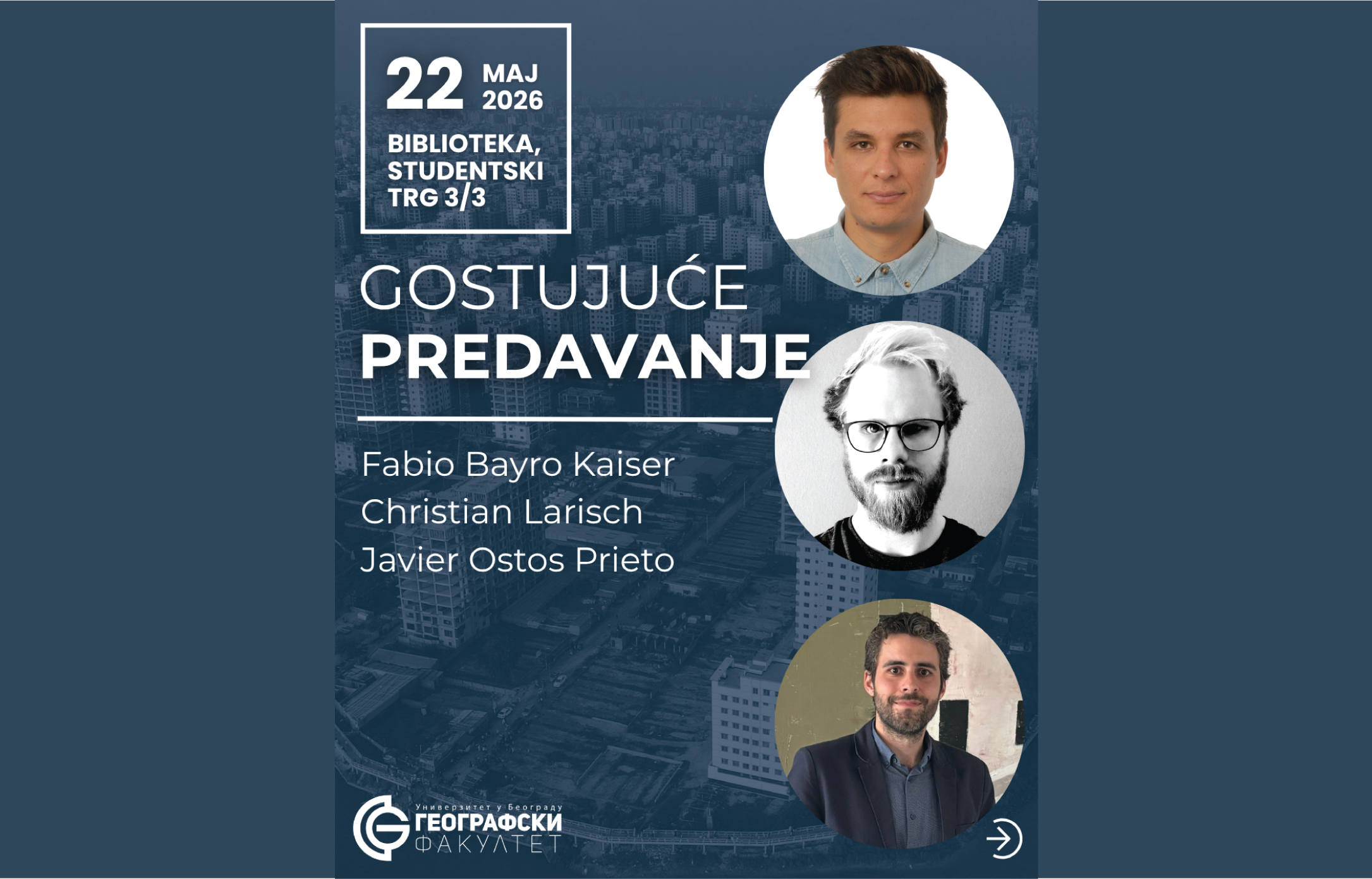
Gostujuća predavanja: Dr. Fabio Bayro Kaiser, Christian Larisch & Dr. Javier Ostos Prieto
Datum: 22.05.2026.
Lokacija: Biblioteka, Studentski trg 3/3
Satnica održavanja predavanja:
09:00 Introduction: Transforming City Regions (Fabio Bayro Kaiser)
09:30 Negotiating urban transformation across scales in conditions of uncertainty: Circular built EuroDelta 2050+ (Fabio Bayro Kaiser)
Cities face growing pressure from climate, housing, and limited resources, yet many projects fail not due to a lack of ideas, but because systems and actors remain misaligned across scales. The talk thus focuses on urban transformation as a continuous negotiation, where decisions in one place affect others and must adapt to uncertain conditions, drawing on results from a collaborative project in the EuroDelta region with around 45 million inhabitants. It offers a simple way to understand this by linking flows, spaces, and governance, and shows how design helps connect them. Seeing transformation as coordination across systems helps make better decisions by working with complexity and uncertainty.
Dr. Fabio Bayro Kaiser is a Research Associate at the Chair and Institute of Urban Design at the Faculty of Architecture, RWTH Aachen University, and an Associate at RHA Reicher Haase Architecture and Urban Planning. His research and teaching focus on urban design, urbanisation dynamics, and transformation of city regions. Prior to this, he was a research assistant at the Department of Urban Design at the Faculty of Spatial Planning, TU Dortmund University, and a partner at M.Kaiser Architecture and Urban Planning in Bolivia.
10:15 Planning for the long term: A spatial strategy for the Rhenish Mining Region (Christian Larisch)
The Rhenish Mining Region is currently undergoing a profound socio-economic and spatial transformation. The mandated phase-out of lignite extraction presents a unique set of structural challenges, requiring a fundamental reconfiguration of a region characterized by deep industrial legacies and internal heterogeneity. As traditional statutory planning instruments often reach their limits in addressing the multi-layered complexities of such a transition, the need for agile, long-term spatial visions becomes imperative. This contribution provides a comprehensive analysis of these challenges and introduces the „Raumstrategie Rheinisches Revier 2038+“—an ambitious informal planning process designed to navigate the uncertainties of the post-mining era. By detailing the methodology and the strategic approach of this process, the lecture illustrates how visionary spatial strategies can bridge the gap between immediate structural aid and sustainable regional development. Furthermore, the discussion reflects on the broader significance of informal guiding principles (Leitbilder) in contemporary regional planning, showcasing their role as essential catalysts for identity-building and strategic coordination in regions under immense pressure to adapt.
Christian Larisch is working as a Research Associate at the Chair of Urban Design and the Institute of Urban Design and European Urbanism at RWTH Aachen University since 2020. He holds a degree in Spatial Planning from TU Dortmund University. His research interests include Transit-Oriented Development (TOD), the interactions between mobility and space, strategic spatial development, urban and regional planning, as well as future-oriented structural change in the Rhenish mining area. In addition to his role at RWTH Aachen, he is active in various working groups of the Academy for Territorial Development in the Leibniz Association (ARL).
11:00 Coffee break
11:30 From extraction to attraction: Strategies for urban and regional recovery in Rio Tinto, Spain (Javier Ostos Prieto)
The shift “from extraction to attraction” in Rio Tinto (Huelva) reflects a broader transformation of post-industrial regions seeking new paths beyond resource-dependent economies. Once defined by intensive mining activity, the area is increasingly reimagined through its cultural, historical, and environmental assets. This transition highlights the importance of valuing industrial heritage, restoring degraded landscapes, and fostering new forms of economic activity such as tourism and innovation. At the same time, it underscores the role of local identity, community involvement, and strategic planning in shaping resilient futures. Rio Tinto thus serves as an example of how former extraction-based territories can redefine themselves as attractive and sustainable places to live, visit, and invest in.
Dr. Javier Ostos Prieto, Architect (2017), Master in Architecture and Historical Heritage (2018) and Master in Urbanism, Planning and Urban Design (2020) by Seville University. Doctor in Architecture by Seville University and RWTH Aachen University (2024). He is a Research Associate at the Chair of Urban Design and Institute for Urban Design and European Urbanism at the Faculty of Architecture, RWTH Aachen University; member of the teaching and coordination team of the Master Transforming City Regions and coordinator of the UNESCO Chair Cultural Heritage and Urbanism (2024-present).
12:15 Discussion: Adaptation, transition, or systemic change?